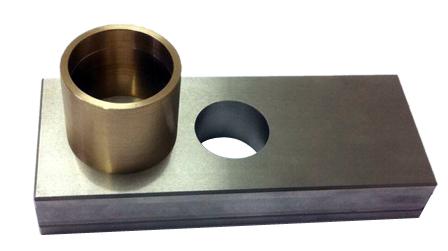
The Model 312 Arnold Density Meter is a product used to measure the apparent density of powders.
This instrument enables the user to determine the density of any powder or mix, whether or not the powder has flow characteristics. It simulates the action of the feed shoe of the press. The values obtained on metal powders are approximately 0.2 g/m3 higher than those obtained with:
Hall,Test method ASTM B 212
Carney Test method ASTM B417
Scott,Test Method ASTM B 329
Model 312 Arnold Density Meter
This test method consisits of slowly sliding a bushing partially filled with powder over a hole in a hardened steel block, collecting and weighing the powder, and calculating its apparent density.
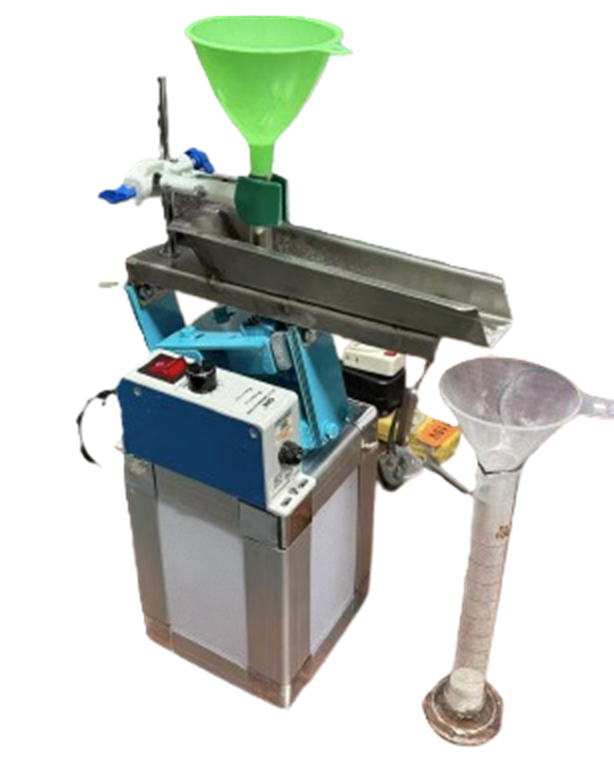
The Model 325 Activated Carbon Bulk Density Tester is used to measure the packed bulk density(apparent density) of granular activated carbon. Put sample into a reservoir funnel and adjust the frequency of a vibratory feeder, the sample is filled via a feed funnel into a graduated cylinder. Weigh the sample inside and calculate the bulk density.
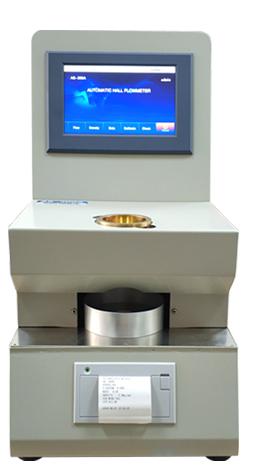
The Model AS300A Hall Flowmeter (Funnel) /Hall Flow Meter (Funnel) determines both Flow Rate and Apparent Density. It is applicable to both free-flowing metallic powders and other fine powders testing. The testing is performed with a calibrated hall flowmeter funnel according to International Standards
The Model AS300A Hall Flowmeter (Funnel) /Hall Flow Meter (Funnel) determines both Flow Rate and Apparent Density. It is applicable to both free-flowing metallic powders and other fine powders testing. The testing is performed with a calibrated hall flow meter funnel according to International Standards: ASTM B213Standard Test Method for Flow Rate of Metal Powders
ISO 4490 (JIS Z 2502) Metallic powders - Determination of flow rate by means of a calibrated funnel (Hall Flowmeter)
ASTM B212 Standard Test Method for Apparent Density of Free Flowing Metal Powders Using the Hall Flowmeter Funnel
ISO No. 3923-1 Metallic powders - Determination of apparent density - Part 1 Funnel method
MPIF No.4 Std. 04—Apparent Density of Free-Flowing Metal Powders Using the Hall Apparatus
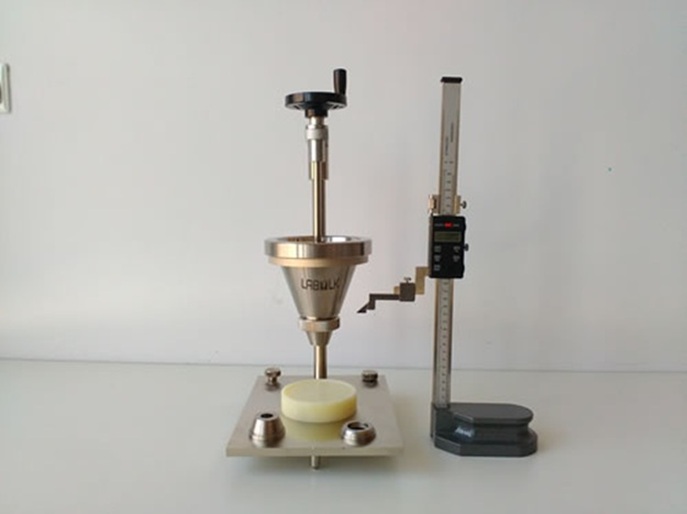
QAQC Model 329, is an apparatus of angle of repose used to measure the angle of repose of pharmaceutical powders.
Powder angle of repose is part of the powder flow test. It conforms to US Pharmacopoeia Chapter USP 1174 and European Pharmacopoeia Chapter EP 2.9.36. It also meets ISO 4324and agricultural fertilizers(ISO 8398).
The angle of repose is the angle of the conical pile produced when a granular sample is poured onto a horizontal surface (test platform). Supplied with free Windows software to obtain the test results in seconds.
It consists of a stand, funnel, stirrer, test platform and a digital height gauge, having a range of 0-300 mm and an accuracy of 0.05 mm.
Pour the sample into the funnel and stir the sample if necessary. The powder produces a cone on the test platform and uses a digital gauge to measure the height of the pile. The tangent of the angle of repose (in degrees) can be determined by reading off the height of the powder cone in mm from the digital display of the height gauge and dividing it by 50.
Table EUROPEAN PHARMACOPOEIA 2.9.36-1. – Flow properties and corresponding angles of repose
• 25-30° Angle of repose corresponds to Excellent flow property
• 31-35° Angle of repose corresponds to Good flow property
• 36-40° Angle of repose corresponds to Fair – aid not needed flow property
• 41-45° Angle of repose corresponds to Passable – may hang up flow property
• 46-55° Angle of repose corresponds to Poor – must agitate, vibrate flow property
• 56-65° Angle of repose corresponds to Very poor flow property
• >66° Angle of repose corresponds to Very, very poor flow property
With solely developed calculation and conclusion software, operator can easily obtain results of powder flowability.




 HOME
HOME